DC basics · 3 min read
Ohms Law Current: the method, worked through
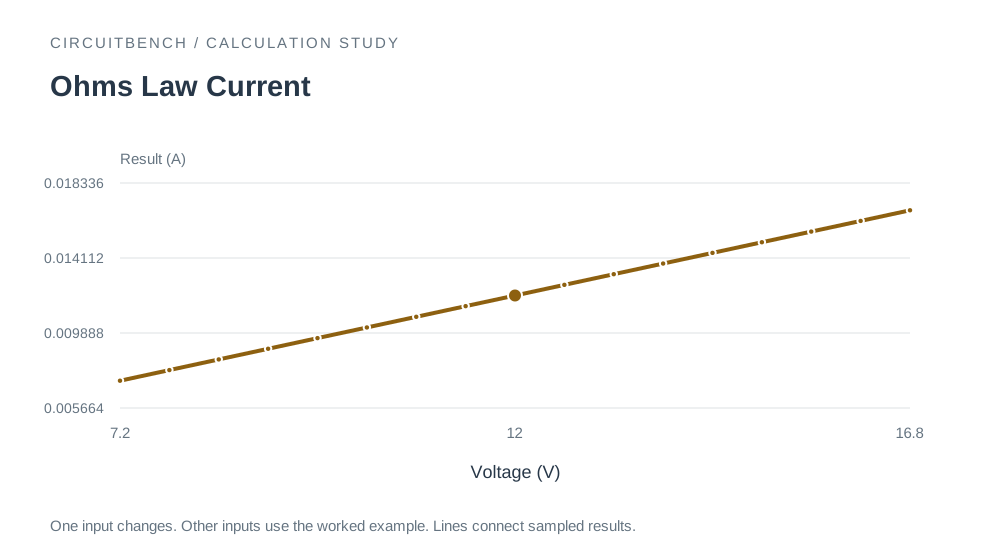
Ohm's law predicts current through an ideal linear resistor at a given voltage.
A compact workbench for ideal low-voltage DC and introductory AC calculations.
DC basics · 2 inputs
Ohm's law predicts current through an ideal linear resistor at a given voltage.
Open calculator ↗The voltage drop across a linear resistor follows the product of current and resistance.
Open calculator ↗A voltage-current pair determines the effective resistance of an ohmic component.
Open calculator ↗DC power is the rate of electrical energy transfer at a fixed voltage and current.
Open calculator ↗Resistive heating grows with the square of current.
Open calculator ↗A resistor exposed to a fixed voltage dissipates power inversely proportional to its resistance.
Open calculator ↗Resistors in a single current path add directly.
Open calculator ↗Parallel resistors share the same voltage and add their conductances.
Open calculator ↗Three parallel branches contribute conductance to a shared pair of nodes.
Open calculator ↗An unloaded two-resistor divider sets a fraction of the input voltage at its midpoint.
Open calculator ↗Rearranging the divider relation finds the lower resistor for a target unloaded voltage.
Open calculator ↗A series resistor drops the supply voltage remaining after an LED's forward drop.
Open calculator ↗The resistor dissipates the voltage it drops multiplied by the LED current.
Open calculator ↗Tolerance describes the permitted deviation from a nominal resistor value.
Open calculator ↗Parallel capacitors share a voltage while their stored charges add.
Open calculator ↗Ideal series capacitors carry equal charge, giving reciprocal addition of capacitance.
Open calculator ↗Capacitance relates stored charge to voltage across the capacitor.
Open calculator ↗Energy stored in an ideal capacitor grows with the square of voltage.
Open calculator ↗The RC time constant sets the speed of a first-order charging or discharging response.
Open calculator ↗A capacitor initially at zero volts approaches a fixed supply exponentially through a resistor.
Open calculator ↗An initially charged capacitor loses voltage exponentially through an ideal resistance.
Open calculator ↗A first-order RC low-pass cutoff is the frequency where amplitude falls to one over the square root of two.
Open calculator ↗An ideal capacitor's reactance magnitude decreases as frequency rises.
Open calculator ↗An ideal inductor's reactance magnitude increases with frequency.
Open calculator ↗An ideal inductor stores energy in its magnetic field.
Open calculator ↗Uncoupled series inductors add their inductances.
Open calculator ↗Uncoupled ideal parallel inductors combine by reciprocal addition.
Open calculator ↗An RL time constant sets the exponential current response in a first-order circuit.
Open calculator ↗An ideal LC pair exchanges energy between electric and magnetic storage at its natural resonance.
Open calculator ↗The impedance magnitude combines resistive and net reactive parts at a specified frequency.
Open calculator ↗A sinusoid's RMS voltage produces the same resistor heating as the equivalent DC voltage.
Open calculator ↗A sine-wave peak is the RMS level multiplied by the square root of two.
Open calculator ↗Apparent power is the product of RMS voltage and current.
Open calculator ↗Real power uses power factor to account for the relationship between voltage and current.
Open calculator ↗Power factor compares real power with the RMS-based apparent power.
Open calculator ↗Nominal battery energy combines a rated voltage with charge capacity.
Open calculator ↗A constant-power load consumes stored usable energy at a steady rate in the ideal model.
Open calculator ↗Converting milliampere-hours to watt-hours makes capacities at different voltages comparable.
Open calculator ↗A constant-current charge model estimates the time to transfer a specified amount of charge.
Open calculator ↗In two parallel resistive branches, more current takes the lower resistance path.
Open calculator ↗An ideal non-inverting op-amp circuit sets gain through its feedback ratio.
Open calculator ↗An ideal inverting amplifier reverses signal polarity and scales its magnitude by a resistor ratio.
Open calculator ↗An amplitude ratio maps to decibels with a factor of twenty.
Open calculator ↗Decibels express power ratios on a logarithmic scale.
Open calculator ↗Exponentiation reverses an amplitude-gain decibel value.
Open calculator ↗Period and frequency are reciprocal measures of repetition.
Open calculator ↗Duty cycle expresses the fraction of a repeating period spent high.
Open calculator ↗A zero-low-level PWM signal has an arithmetic mean set by its high level and duty fraction.
Open calculator ↗An ideal ADC divides a reference span into equally spaced quantization intervals.
Open calculator ↗An ideal unipolar ADC maps the input into a quantization bin.
Open calculator ↗No matching tools. Try a shorter search or choose all categories.
Ohm's law predicts current through an ideal linear resistor at a given voltage.
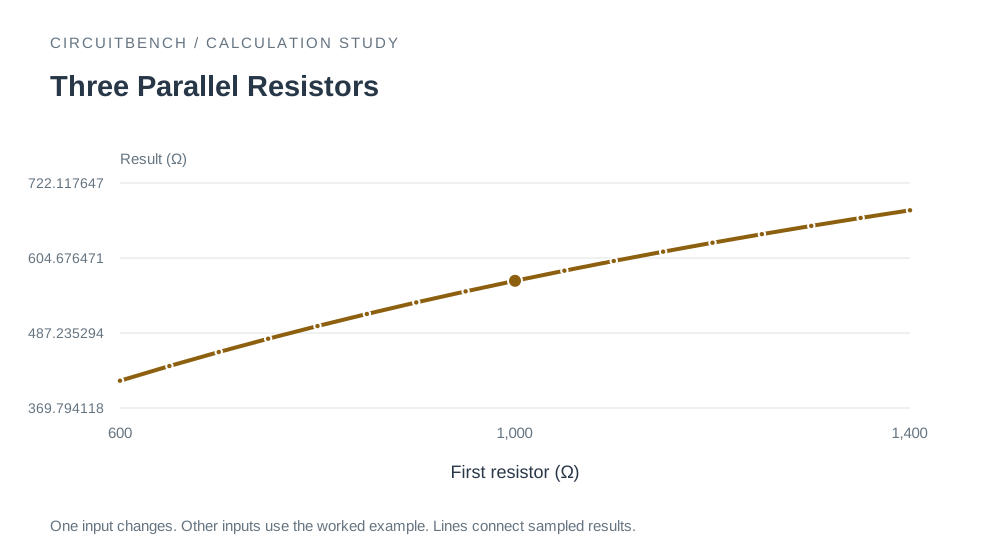
Three parallel branches contribute conductance to a shared pair of nodes.
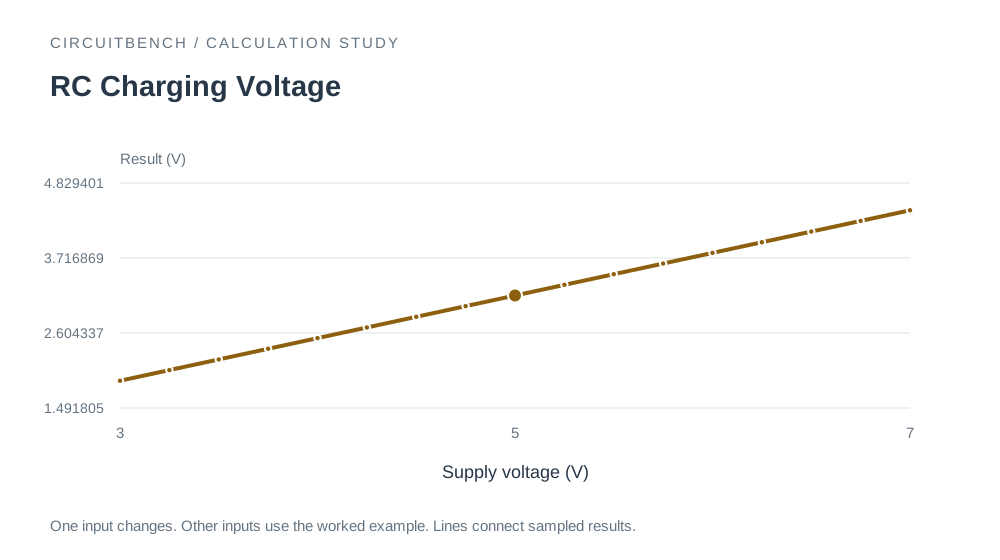
A capacitor initially at zero volts approaches a fixed supply exponentially through a resistor.